
NATO summit in Ankara expands Black Sea security pact, reaffirms Ukraine aid amid defense spending tensions
Story Timeline
3 months · 10 summary articles
The NATO summit in Ankara has concluded with significant agreements and reaffirmations of commitment, but also exposed underlying tensions within the alliance. On the sidelines of the summit, Türkiye, Romania, and Bulgaria announced their intention to sign a new agreement expanding their trilateral MCM Black Sea operation to include the protection of critical underwater infrastructure in the Black Sea, including energy projects such as Neptun Deep.
In an exclusive interview with CaleaEuropeană.ro, Türkiye’s Ambassador to Romania, Özgür Kıvanç Altan, stressed the importance of the personal relationship between President Recep Tayyip Erdoğan and U.S. President Donald Trump in strengthening NATO unity. "Our President, Recep Tayyip Erdoğan, is a world leader… He has a very good, sincere and genuine relationship with President Trump. If this is to the benefit of our Alliance, then it is a wonderful thing. We will make use of this closeness," Altan said.
The summit, held at a critical time for the alliance, saw leaders grappling with issues of defense spending and industrial output. While the summit did not alter the direction of U.S. force reductions in Europe, it produced significant practical outcomes in defense-industrial cooperation. For instance, Germany agreed to purchase U.S. Tomahawk cruise missiles, and Rheinmetall signed a preliminary agreement with Lockheed Martin to jointly produce ATACMS missiles in Germany.
European countries expressed mixed reactions. Latvian President Edgars Rinkevics described the summit as positive, highlighting the reaffirmation of collective defense commitments under Article 5 of the NATO Treaty and the extension of Canada's military presence in Latvia until 2031. "The prevailing sentiment at the summit was that Europe needs America, America needs Europe, and Europe must assume greater responsibility for its own defense," Rinkevics said.
NATO leaders also reaffirmed their commitment to provide Ukraine with EUR 140 billion in military aid in 2026 and 2027, underscoring the alliance's continued support for Ukraine amid ongoing tensions with Russia.
However, the summit was not without its tensions. U.S. President Donald Trump criticized European allies for insufficient defense spending and support in the war with Iran. "Higher defense spending has not, in itself, eased political friction," noted Nadiia Koval, a policy fellow at the European Policy Institute in Kyiv.
The summit also saw discussions about the future of European defense industry cooperation. Saab, for example, secured contracts for Gripen E fighter jets and GlobalEye airborne early warning aircraft, illustrating the shift towards European-made defense equipment.
Overall, the Ankara summit highlighted both the strengths and challenges of the NATO alliance. While significant agreements were reached and commitments reaffirmed, the underlying tensions over defense spending and industrial cooperation remain unresolved.
Follow us for live European news
- 1
- 1
- 1
6 further sources not geolocated
Articles

NATO summit begins in Ankara today - The Baltic Times RIGA - The NATO summit will take place in the Turkish city of Ankara today and tomorrow. Latvian President Edgars Rink......
baltic times · about 2 months ago
NATO summit provided Latvia with assurances regarding importance of collective defense commitments - Rinkevics - The Baltic Times RIGA - Latvias security has been strengthened by the outcome of the NATO summit in Turkey, President Edgars Rinkevics said on social media,......
baltic times · about 2 months ago

US allies apprehensive after capricious Trump changes tune at Nato summit | Donald Trump | The Guardian the unexpectedly emollient finale, a school of thought has emerged that Trumps regular bashing of allies will leave a permanent mark – even if he is eventually replaced by an administration with a more traditional view of the transatlantic alliance."#Trump #NATO
mastodon bot · about 2 months ago
Türkiye, TRNC leaders discuss energy projects, underline shared future Vice President Cevdet Yilmaz said Ankara will continue supporting projects to improve Turkish Cypriot welfare and strengthen production capacity during talks in Lefkosa on Friday, adding that the 101-kilometer undersea pipeline marks a historic milestone in bilateral cooperation.
yenisafak · about 2 months ago
Türkiye hosts Lebanese premier in Istanbul for talks Turkish President Recep Tayyip Erdogan hosted Lebanese Prime Minister Nawaf Salam at the Vahdettin Mansion in Istanbul on Friday for a working dinner, during which the leaders discussed bilateral relations, regional security, and Ankaras commitment to providing humanitarian assistance to Beirut.
yenisafak · about 2 months ago
Apple to spend $30 billion on Broadcom chips as it boosts US sourcing Apple (AAPL.O) plans to spend more than $30 billion under a multi-year chip supply deal with Broadcom, bolstering its US sourcing as President Donald Trumps administration pushes to expand domestic chip manufacturing. Broadcom shares rose more than 4 per cent, while Apple shares were down marginally. Apple said this week that the deal, which was […]
cyprus mail · about 2 months ago

NATO Summit Boosts European Defence Stocks and Contractors #Europe #NATO
mastodon bot · about 2 months ago
Türkiyes first lady hosts Lebanese premiers wife in Istanbul First lady Emine Erdoğan on Friday welcomed Sahar Baassiri, wife of Lebanese Prime Minister Nawaf Salam, to Istanbul, thanking her for the visit and expressing hope for continued friendship between the two nations, according to a statement on social media.
yenisafak · about 2 months ago
Is there a better way to bring natural gas to Cyprus? The first two articles in this series concluded that the key question facing Cyprus is no longer whether natural gas is needed, but whether the current Vasiliko LNG import project remains the most economic way of supplying it. Natural gas still offers important advantages. It would reduce carbon emissions, improve the efficiency of electricity generation, […]
cyprus mail · about 2 months ago

The Ankara summit brought greater clarity to support for Ukraine. The central question, however, was left unresolved: the trajectory of American disengagement from European security, writes Nadiia Koval, Policy Fellow at the European Policy Institute in Kyiv, in her op-ed.
bluesky_Kyiv Independent · about 2 months ago
An end to PV curtailments is coming – just not yet A contract signed last month for a large-scale, centrally managed storage batteries system is anticipated to be followed by other such projects, the Cyprus Mail is told, as the island gradually transitions to accommodate a growing penetration of renewables in the energy mix. Back in June the Transmission System Operator (a state entity) and the […]
cyprus mail · about 2 months ago
G7 to announce long-term Ukraine security package at NATO summit
gdeltproject.org · about 2 months ago
Four centres of power shape the Rights race to Cypruss 2028 presidential election The strategic plans of the main power centres on the Right are beginning to unfold ahead of a long road, with many stages still to come, towards the 2028 presidential election. Nicos Christodoulides on one side, and Annita Demetriou, Averof Neophytou and George Pamboridis on the other, are currently the four main poles around which […]
in-cyprus · about 2 months ago
The sovereign sandbox: turning the August AI deadline into an advantage for Cyprus By Stephanos Spyrou Cyprus is one of Europes smallest nations, but for six months this year it held the gavel for the whole European Union, and used the closing days of that turn rather well: steering the Council to its own sign-off on the very AI Act simplification package that is about to decide how […]
cyprus mail · about 2 months ago
Canada will extend Operation Reassurance mission until 2031 - The Baltic Times ANKARA - Canadian Prime Minister Mark Carney told Latvian President Edgars Rinkevics on Wednesday during the NATO summit in Ankara that Canada w......
baltic times · about 2 months ago
Multiple New York Times reporters issued subpoenas over Air Force One reporting The Trump administration issued subpoenas on Friday to several New York Times journalists after its report this week on security concerns involving the new Air Force One, according…
japantoday · about 2 months ago
Türkiye vows continued support for Northern Cyprus energy security Energy Minister Alparslan Bayraktar has pledged that Türkiye will maintain technical, infrastructure, and institutional support for the Turkish Republic of Northern Cyprus energy security following a visit to the strategic Teknecik Power Plant with TRNC officials.
yenisafak · about 2 months ago
EXCLUSIVE | Türkiyes Ambassador: Romania, Türkiye and Bulgaria to expand the MCM Black Sea operation to protect critical infrastructure; Ankara counts on the Erdoğan–Trump relationship to save NATO Summit
gdeltproject.org · about 2 months ago
Cyprus Business Now: weekly wrap-up Here are the top business stories in Cyprus from the week starting July 6: As Cyprus property and construction sectors continue to expand in 2026, the countrys real estate market stands at a defining moment, combining strong investment, sustained development activity and rising demand with increasingly complex challenges surrounding affordability, infrastructure, planning and long-term sustainability. […]
cyprus mail · about 2 months ago
Guterres expresses deep concern over advances into Pyla buffer zone United Nations Secretary-General Antonio Guterres has expressed deep concern over advances made by Turkish and Turkish Cypriot personnel into the buffer zone near the village of Pyla, near Larnaca, in an advance copy of his latest report on the status of the UNs peacekeeping force in Cyprus (Unficyp) seen by the Cyprus Mail on Sunday. The authorities […]
cyprus mail · about 2 months ago
Türkiye becoming pole of new international system: Erdogan President Recep Tayyip Erdogan said on Friday that Türkiye is advancing toward becoming "one of the poles of the new international system" amid a radical transformation in global security, highlighting record defense exports exceeding $11 billion and an 82 domestic production rate.
yenisafak · about 2 months ago
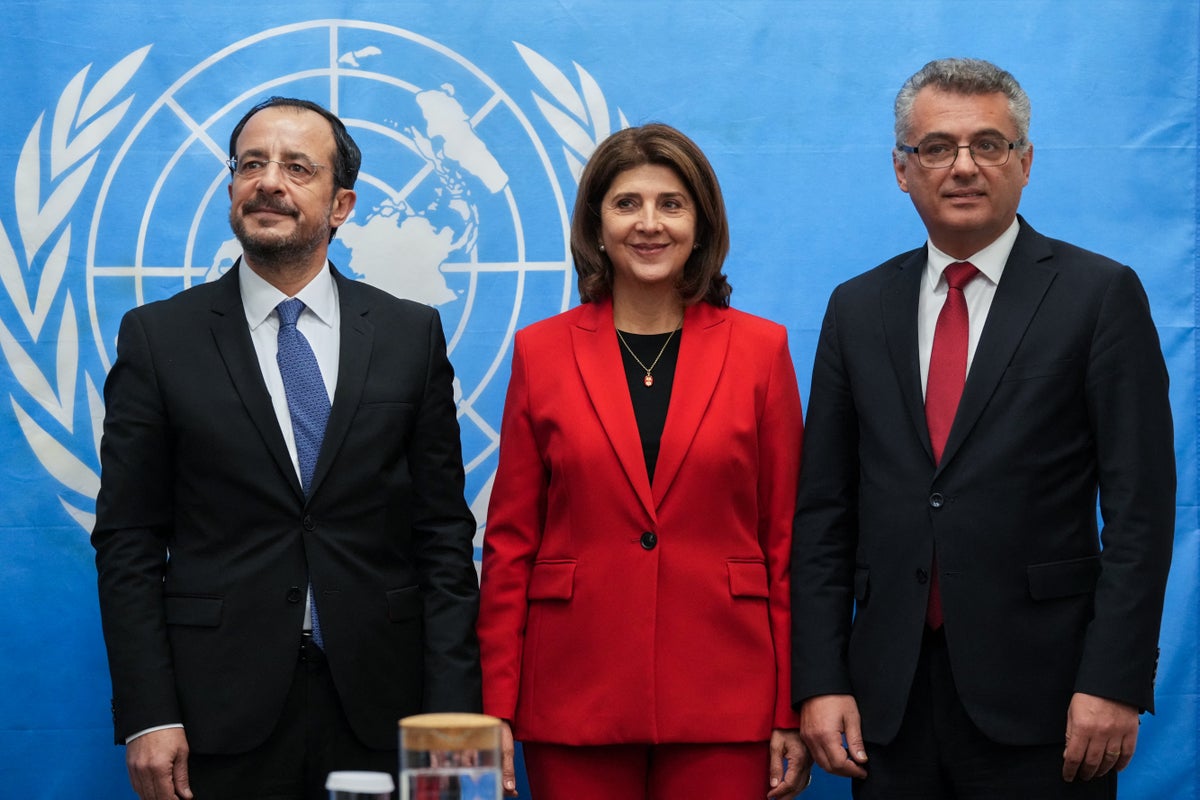
UN draws up new blueprint to end Cyprus crisis after 52 years of stalemate María Ángela Holguín, the UN secretary-generals personal envoy for Cyprus, has been working on a deal which is flexible enough for both sides to claim they have got what they want
independent · about 2 months ago

⚡ NEWSTrumps erratic behavior at NATO summit in AnkaraUS allies express apprehension after Donald Trump displays volatile and capricious behavior at the NATO summit in Ankara. Commentators note his performance was extreme, with speculation linking the shift to an affinity for Turkish President Erdoğan.📰 #Diplomacy #Military #Geopolitics #GeoWire
mastodon bot · about 2 months ago
Our View: Linking the Cyprus issue to EU-Turkey relations is just an obstacle When President Nikos Christodoulides persuaded the European Union to make EU-Turkey relations dependent on progress on the Cyprus problem, this was presented as great achievement. The linking of the two was seen as an effective way of persuading Ankara to adopt a more constructive approach to the Cyprus problem and abandon its insistence on a […]
cyprus mail · about 2 months ago
NATO summit in Ankara must demonstrate the alliances unity - Rinkevics - The Baltic Times RIGA - At the NATO summit in Ankara, the alliance must demonstrate that, despite discussions and disputes, it is capable of standing united, Pre......
baltic times · about 2 months ago
Azerbaijan and Türkiye deepen defense ties with Baykar talks Azerbaijani Defense Minister Zakir Hasanov and Baykar Chairman Selcuk Bayraktar have held high-level talks in Baku to expand joint defense production. Discussions focused on unmanned aerial vehicles, electronic warfare systems, and advanced unmanned technologies, signaling a major step forward in bilateral military-industrial cooperation between the two allied nations.
yenisafak · about 2 months ago
Türkiye signs Hisar air defense serial production contracts Secretary of Defense Industries Haluk Gorgun announced on Friday that Türkiye has signed additional serial production contracts with Aselsan and Roketsan for the Hisar-A and Hisar-O air defense systems, advancing the countrys multi-layered Steel Dome architecture under NATO commitments.
yenisafak · about 2 months ago
Türkiye rejects European Parliament resolution on 1974 Cyprus operation Vice President Cevdet Yilmaz said the European Parliaments resolution on the 1974 Cyprus Peace Operation is "null and void," rejecting the measure as a tool of Greek Cypriot propaganda that undermines the assemblys credibility while urging lawmakers to examine the situation in Gaza rather than engage in historical revisionism.
yenisafak · about 2 months ago
NATO Ankara summit highlights Türkiyes peace role: Communications chief Presidential Communications Director Burhanettin Duran said the NATO Ankara Summit demonstrated Ankaras active leadership in strengthening international security and the transatlantic bond through intensive high-level diplomatic engagements with Western allies.
yenisafak · about 2 months ago
TRNC condemns European Parliament resolution on Cyprus The Turkish Republic of Northern Cyprus on Thursday dismissed a European Parliament resolution on Cyprus as "null and void," accusing the institution of deliberately distorting the realities of the 1974 intervention and adopting a biased approach that targets both Türkiye and the Turkish Cypriot people.
yenisafak · about 2 months ago