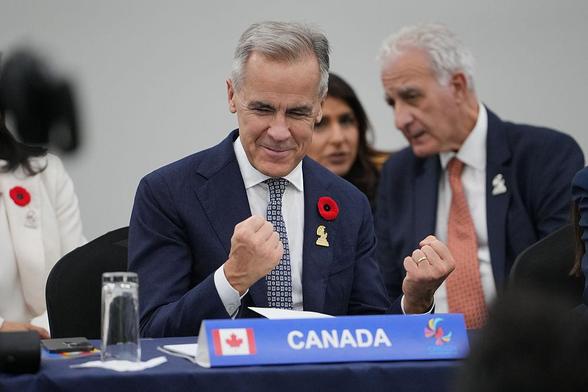
Prime Minister Mark Carney said Canada and the United States have entered an intensive phase of trade negotiations while Ottawa simultaneously deepens economic ties with the European Union to counter American tariffs.
President Donald Trump's planned 50 percent tariff on a range of Canadian imports, from wine to hockey sticks, is expected to hit about 5 percent, or $20 billion, worth of goods, though energy, potash and fish are excluded. Carney has promised to take "any measures necessary" to protect Canadian workers, farmers and businesses, likely by moving away from reliance on a single major trading partner.
Speaking on Tuesday during the Commonwealth Heads of Government Meeting in Antigua and Barbuda, Carney said discussions with Washington had accelerated following his recent telephone conversation with Trump. The United States has backed away from several proposals Ottawa previously considered unacceptable, particularly those affecting Canadian cultural protections, the French language and Canada's sovereign authority to negotiate trade agreements with other countries. The renewed talks follow the breakdown of formal negotiations in August. Carney said US negotiators are "asking less and they're offering more," though significant disagreements remain unresolved.
To reduce over-reliance on the US market, Canada has pursued trade diversification with non-US partners, a strategy that has become more ambitious under Carney, particularly with Europe and the Indo-Pacific. Trade between Canada and the EU stood at €130.8 billion in 2025, up 81.2 percent since the Comprehensive Economic and Trade Agreement (CETA) was signed in 2016. The agreement, provisionally applied since 2017, removed nearly 98 percent of tariffs. The EU reports its GDP has increased by €3.2 billion each year because of the deal.
Raw materials, rare earths and energy are central to the deepening Canada-EU relationship. Canada's natural resources appeal to the EU, which seeks to reduce reliance on China for rare earths while meeting environmental targets. Canada and several member states including Germany and France are engaging in raw materials partnerships. Canada recently signed a preliminary energy agreement with Germany for one million tonnes per year of liquefied natural gas from the proposed Ksi Lisims project on British Columbia's coast. The project has yet to receive approval amid opposition from indigenous and environmental groups.
Despite the removal of most tariffs, EU regulations on some goods remain a barrier for Canadian exporters. The EU could be a major destination for Canadian food products, but protectionist policies in agriculture continue to keep Canadian food products at a competitive disadvantage, according to Julian Karaguesian, an economics lecturer at McGill University.
A dispute over the future institutional relationship is deepening a split between European Commission President Ursula von der Leyen and German Chancellor Friedrich Merz. Von der Leyen proposed making Canada an "associate member" of the EU at a summit in Montreal last week. The move came just hours after a German-led push removed the wording from a joint statement approved by 27 EU capitals. Berlin sees the phrase as a rebuke of Merz's earlier initiative to use "associate member" as a status for Ukraine. Von der Leyen's definition would grant the status to a country that could never be fully admitted to the EU, precluding it from being offered to Ukraine.