
Zelenskyy warns Lukashenko: halt Russia ties or face consequences
Story Timeline
4 months · 18 summary articles
Ukraine’s President Volodymyr Zelenskyy has issued a seven-day ultimatum to Belarusian leader Alexander Lukashenko, warning that failure to halt military cooperation with Russia along their shared border will trigger unspecified consequences. The demand, reported on Friday, follows escalating tensions as Kyiv accuses Minsk of facilitating Russian troop movements and logistical support for Moscow’s war effort in Ukraine.
Speaking to reporters in Kyiv, Zelenskyy reiterated his call for the European Union to fast-track Ukraine’s membership, arguing that this remains the surest path to securing Europe’s future amid the ongoing conflict. “The best way to guarantee Europe’s future would be fast-track EU membership for Ukraine,” he stated, a position echoed in multiple interviews published on Saturday.
The ultimatum to Lukashenko comes as EU leaders remain deeply divided over whether to reopen dialogue with Moscow, despite repeated demands for a full, unconditional Russian ceasefire. On Thursday, EU leaders reaffirmed their “firm and unwavering support” for Ukraine and insisted that any peace process must include Kyiv and respect Ukraine’s territorial integrity.
Russia, however, has rejected the notion of ultimatums, with Foreign Minister Sergey Lavrov stating in a June 19 article that Moscow is open to dialogue but will not accept demands imposed from outside. “We are ready for talks, but not for ultimatums,” Lavrov wrote in an op-ed titled *Ukraine, Europe and Global Security*.
The internal EU debate over engagement with Russia has intensified, with some member states reportedly pursuing backchannel communications with the Kremlin. Portuguese Prime Minister António Costa’s reported outreach to Moscow has sparked outrage in Eastern Europe, particularly in Estonia, where the prime minister condemned the move as a betrayal of Ukraine.
Zelenskyy also indicated that negotiations with Russia may resume, though the format remains undecided. He emphasized that Ukraine’s European partners favor a joint negotiating track with the United States, stressing that Kyiv seeks security guarantees and EU membership as prerequisites for any lasting peace.
Meanwhile, the EU is exploring alternative energy and trade corridors, including a revived India-Middle East-Europe corridor, as a response to ongoing disruptions in global energy markets following recent conflicts in the Middle East.
As the war in Ukraine enters its third year, the continent’s political fault lines are widening, with divisions over strategy toward Moscow threatening to undermine the bloc’s unity just as Kyiv presses for decisive action on membership and security.
Follow us for live European news
- 1
- 1
- 1
3 further sources not geolocated
Articles

Cum a modelat lumea interlopă din Sankt Petersburg „mentalitatea de mafiot a lui Putin: „Nu au jocuri în care toată lumea câștigă Un om de afaceri înstărit, care are legături cu Vladimir Putin, a fost arestat la Sankt Petersburg în legătură cu o crimă la comandă, ceea ce a readus în prim-plan activitățile președintelui rus din acest oraș în anii 90, o perioadă „sălbatică. Ilia Traber a fost reținut miercuri de agenții de securitate ai FSB și dus la Moscova pentru a fi interogat în legătură cu moartea, survenită în 2020, a lui Alexander Petrov, un om de afaceri și politician din oraș, au relatat mass-media ruse, conform The Times.
digi24 · 3 months ago
Svenske toppdiplomaten: Putin och Trump gör samma misstag Putin och Trump har gjort samma misstag.Det säger svenske toppdiplomaten Olof Skoog.– Det har skapat större enighet i EU, säger Skoog till Svenska Dagbladet.
expressen · 3 months ago
Russia: Decades of Russian Secret War Against Europe
gdeltproject.org · 3 months ago
Russia will not achieve its aggressive objectives, and Ukraine will be a free, democratic country within EU - Braze - The Baltic Times RIGA - Russia will not achieve its aggressive goals, and Ukraine will be a free, democratic country within the European Union (EU), emphasized F......
baltic times · 3 months ago
Zelenskyy meets EU leaders at Brussels summit President Volodymyr Zelenskyy held talks with European Council President Antonio Costa and Commission President Ursula von der Leyen at the EU summit in Brussels. He urged the opening of five remaining negotiating clusters and requested the first tranche of EU financial support for defense.
yenisafak · 3 months ago
EU demands Russian ceasefire, vows unwavering Ukraine support European Union leaders on Thursday reaffirmed their "firm and unwavering support" for Ukraine and pressed Moscow to accept a full, unconditional ceasefire, warning that the path to peace cannot be decided without Kyiv and that borders must not be changed by force.
yenisafak · 3 months ago
EU leaders urge decisively ramped up defense by 2030 European Union leaders concluded a Brussels summit on Thursday with a call to accelerate defense preparedness "decisively ramped up" by 2030, condemning a recent Russian drone strike in Romania and urging member states to close critical capability gaps while maintaining NATO as the bedrock of continental security.
yenisafak · 3 months ago
EU should fast-track membership for Ukraine
gdeltproject.org · 3 months ago
Zelensky: Best way to guarantee Europes future would be fast-track EU membership for Ukraine
gdeltproject.org · 3 months ago
Zelensky urges EU to fast-track Ukraines path to membership - Jowhar News Leader
gdeltproject.org · 3 months ago
EU Revives Interest in India–Middle East–Europe Corridor After Iran War Energy Shock
gdeltproject.org · 3 months ago
Zelenskyy urges opening remaining negotiation clusters on Ukraines accession to EU before end of Cyprus presidency
gdeltproject.org · 3 months ago
Zelenskiy: best guarantee of Europes future is fast-track EU membership for Ukraine
gdeltproject.org · 3 months ago
Ukraine should become a full member of the European Defence Union, says EU Commissioner Kubilius
gdeltproject.org · 3 months ago
Article by Sergey Lavrov «Ukraine, Europe and Global Security», 19 June 2026
gdeltproject.org · 3 months ago
EU Closes Russian LNG Loophole, Barring European Shipowners and Buyers From Global Trade in Yamal Cargoes
gdeltproject.org · 3 months ago
EU leaders squabble over outreach to Moscow as Ukraine war rages on
gdeltproject.org · 3 months ago
Dispute arisen within EU over whether to open dialogue with Russia regarding war in Ukraine – media
gdeltproject.org · 3 months ago
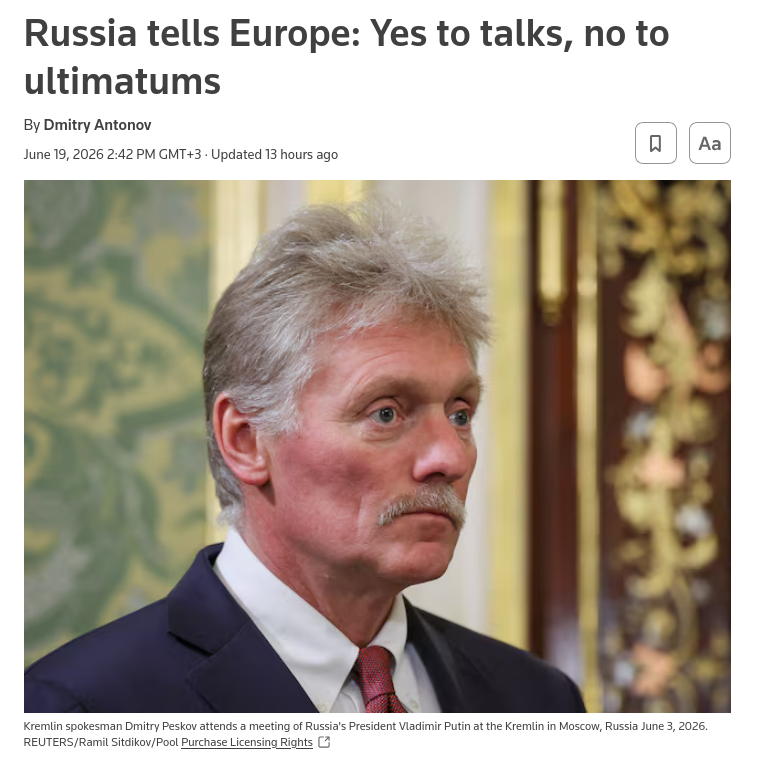
Russia said on Friday it was open to dialogue with European countries but would not accept ultimatums, as signs increase that the EU may seek talks with Moscow after largely shunning contacts since the start of the war in Ukraine. #Russia #EU
mastodon bot · 3 months ago

Would the EU take Britain back? #brexit #EU #Europe #UK
mastodon bot · 3 months ago

KYIV POST: Zelensky Says Russia Talks May Resume, but Format Remains Undecided President Volodymyr Zelensky said he expects negotiations with Russia to resume, though the format remains undecided. He said European partners favor a joint track with the US and stressed that Ukraine wants allies present because Kyiv is counting on security guarantees and EU membership after the war. #Ukraine #World #EasternEurope #Europe
mastodon bot · 3 months ago

EU leaders agree to extend sanctions on Russia for one year #Europe
mastodon bot · 3 months ago