
China's export surge deepens global trade imbalances as domestic demand falters
Story Timeline
4 months · 19 summary articles
China’s surging exports and faltering domestic demand are reshaping global trade flows, as European leaders convene in emergency talks and Asian partners brace for economic fallout. On Tuesday, the European Union’s statistics office reported that the bloc’s trade deficit with China hit a record €31.9 billion in April, with EU imports from China exceeding exports by roughly €1 billion per day . The imbalance has intensified calls for protective measures at the G7 summit, where finance ministers are expected to address what analysts are calling “China Shock 2.0.”
China’s export-driven growth model is straining under the weight of collapsing domestic consumption. Retail sales fell for the first time since the pandemic, while consumer spending has declined for the first time since Covid-19 lockdowns ended . The World Bank and IMF have warned that Beijing’s reliance on external markets risks deepening global imbalances, particularly as Chinese goods flood Europe’s manufacturing sectors. Slovakia’s Prime Minister Robert Fico, visiting New Delhi, praised India’s economic resilience, noting that India’s growth and digital transformation are outpacing many advanced economies .
The geopolitical ripple effects are spreading. In Jakarta, China issued a $50 billion warning to Indonesia over nickel production cuts, signaling Beijing’s willingness to deploy economic leverage to protect its supply chains for electric vehicles . Meanwhile, China and Myanmar’s leaders met in Beijing to deepen bilateral ties, underscoring Beijing’s strategic pivot toward resource-rich neighbors amid Western decoupling efforts .
India, meanwhile, is positioning itself as an alternative hub for global supply chains. Prime Minister Narendra Modi’s visit to Sweden this week highlights India’s push to strengthen ties with Europe as a counterbalance to China’s dominance . The two countries signed memoranda of understanding in defence, digital technology, counter-terrorism, and labour mobility, with Slovakia’s government hailing a “new era of partnership” .
Analysts warn that the divergence between China’s export surge and domestic demand slump could trigger further trade disputes. The EU is considering tariffs on Chinese electric vehicles and solar panels, while Beijing has threatened retaliatory measures. With global growth slowing and protectionist pressures rising, the coming months will test whether the world can absorb China’s economic rebalancing without deeper fragmentation.
Follow us for live European news
- 2
- 1
- 1
- 1
- 1
4 further sources not geolocated
Articles

China embraces Myanmars president as former junta chief seeks legitimacy reut.rs/3S9IPju
bluesky bot · 3 months ago

China, Myanmar pursue deeper ties as leaders hold talks in Beijing reut.rs/4ouUsgE
bluesky bot · 3 months ago

Chinas Consumer Spending Falls for First Time Since Covid The countrys economic growth has become increasingly reliant on exports, stirring up geopolitical tensions.
wsj · 3 months ago

Faster than many advanced countries: Slovak PM Robert Fico praises Indias growth and digital transformation
gdeltproject.org · 3 months ago
PM Modi express gratitude towards his Slovak counterpart Robert Fico for support in India-EU FTA
gdeltproject.org · 3 months ago
Modis Sweden Visit Signals Indias Strategic Pivot in a Changing Global Order
gdeltproject.org · 3 months ago
ETMarkets Smart Talk | Defence and electrification are multi-year structural themes for India: Prateek Agrawal
gdeltproject.org · 3 months ago
Free Nelson Mandela — outstanding documentary traces the long fight against apartheid Three-part Channel 4 film is a feat of filmmaking, harnessing a vast array of voices to tell a complex tale
financial times · 3 months ago
China retail sales sink for first time since Covid Investment slump deepens as divergence widens in second-biggest economy
financial times · 3 months ago
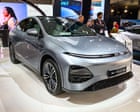
EV prices in UK and EU not likely to dive due to Chinese rivalry, says Xpeng boss Brian Gu says he sees Chinese car firms competing on quality rather than launching price war as at homeMotorists in the UK and EU should not expect a sharp drop in the cost of electric vehicles despite increased competition among Chinese manufacturers, one of the countrys biggest electric carmakers has said.Brian Gu, the vice-chair of the manufacturer Xpeng, said that Chinese carmakers could compete on quality to win customers in the EU and UK, rather than unleashing a brutal price war as they have in China. Continue reading...
theguardian · 3 months ago
Rohstoffe in Afrika: Korridor durch Angola: Mit dieser Bahnlinie stemmt sich die EU gegen Chinas Rohstoffmacht Große Mengen wichtiger Bodenschätze liegen im südlichen Afrika. Bislang werden sie vor allem von China genutzt. Doch mit einem Güterzugkorridor erschließt sich Europa nun den besseren Zugang.
handelsblatt · 3 months ago
Europa se teme de un „șoc chinezesc 2.0, după ce deficitul comercial cu China a atins un nivel record Uniunea Europeană cumpără din China cu aproximativ 1 miliard de euro pe zi mai mult decât exportă către piața chineză, potrivit celor mai recente date publicate de Eurostat. Deficitul comercial dintre cele două economii a ajuns la nivelul record de 31,9 miliarde de euro în luna aprilie, în contextul în care Bruxellesul caută soluții pentru reducerea dezechilibrului și pentru protejarea industriei europene în fața concurenței chineze, scrie The Guardian.
digi24 · 3 months ago
De la paria internațional la partener strategic: ascensiunea lui Kim Jong Un. Cum profită de rivalitatea dintre marile puteri În timp ce atenția Statelor Unite este îndreptată asupra Iranului, un alt lider suprem, aflat la mii de kilometri distanță, își valorifică poziția geopolitică susținută de programul nuclear. Întâlnirea de la vârf, de la începutul acestei săptămâni, dintre liderul suprem nord-coreean Kim Jong Un și președintele chinez Xi Jinping, desfășurată la Phenian, a marcat nu doar o reafirmare a tratatului de apărare reciprocă dintre cele două națiuni, în vigoare de 65 de ani, ci și o ocazie pentru conducătorul nord-coreean de a-și demonstra statutul pe scena mondială. Întâlnirea lui Xi cu Kim, a doua de la vizita liderului nord-coreean din septembrie anul trecut, a demonstrat măsura în care Beijingul consideră Phenianul un actor important la cel mai înalt nivel, arată o analiză publicată de Newsweek.
digi24 · 3 months ago
China issues $50bn warning to Indonesia, slamming nickel production cuts China has issued a multi-billion-dollar warning to the Indonesian government amidst the economic escalation across the global electric vehicle supply chain
intellinews · 3 months ago

Chinas new home prices fall at faster pace in May on soft demand
news.yahoo.com · 3 months ago
China Shock 2.0: Surging Chinese exports threaten Europes economy, raising concern at G7 summit
gdeltproject.org · 3 months ago
Automarkt in China: Autoverkäufe in China brechen ein - droht eine Trendwende? China gilt als Zugpferd für Autoverkäufe, doch seit einigen Monaten gehen die Absatzzahlen deutlich zurück. Experten sind sich uneins, wie es weitergeht. Was bedeutet der Trend für deutsche Autobauer?
tagesspiegel · 3 months ago
China Shock 2.0: Surging Chinese exports threaten Europes economy, raising concern at G7 summit
gdeltproject.org · 3 months ago

Chinas May retail sales fall for first time in over three years reut.rs/4eaJJVk
bluesky bot · 3 months ago